
Can you relate?
You just got promoted to your first management role. You’re excited but also terrified. Everyone tells you “you’ll learn on the job,” but nobody tells you what actually happens in those first few months. You walk into your first team meeting and realize you have no idea how to run it. You need to have a tough conversation with someone and your voice is literally shaking. You thought leadership meant to direct, but now you realize that good leaders seem to actually do something different.
The transition from IC to leader is a completely different world
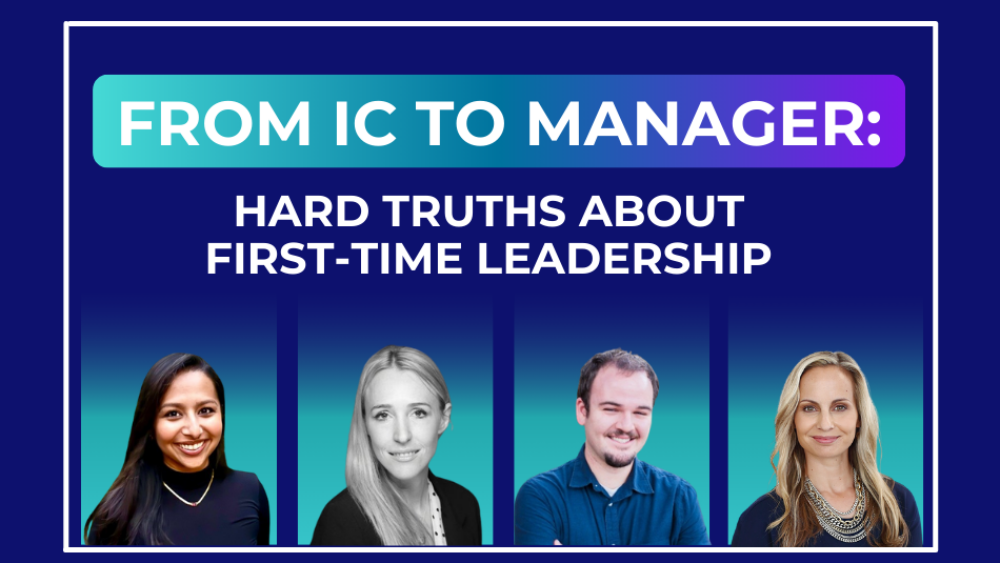
We spoke with three leaders who were participants in our Leadership Accelerator program about this transition and will share their insights with you in this article. One of the leaders manages a Critical Care Transport program in the Bay Area. Another one owns a successful and growing Amazon marketing agency, and our third leader led a reliability engineering guild across a 10,000+ person engineering organization before transitioning into her first official team leader role. All three said the same thing: nothing prepared them for how different this role actually is.
For example, our first leader, Josie, described the shift from bedside nursing to management as moving from a very skill-oriented role to sitting in back-to-back meetings in what felt like a completely different corporate world. The learning curve took at least a year to 18 months, and some days she’s still getting the hang of it.
When you move from IC to leader, give yourself at least 12 months to feel competent in the new role, and accept that some aspects will take even longer to master.
“I went from a bedside nurse working with people, very skill oriented, to managing people and programs. It was a completely different world for me.”
Matt, the agency owner, brought up a critical mindset shift that catches most new leaders off guard. He spent years in consulting where his knowledge was his product. When he started adding people to his team, he approached each new relationship thinking his job was to know everything and be the one they came to for answers. That created dependency instead of interdependence. The more he stepped back, the more magnified their skills became. His role wasn’t to solve every problem. His role was to create space for others to solve problems.
You thought you knew yourself, but leadership puts a spotlight on your blind spots
The first section of leadership development focuses on self-awareness for a reason. Josie said learning about herself was the most important foundation. The more you know yourself, the better you can show up. If you know your weak points and strong points, you can gear your leadership with that knowledge in mind.
Example: Josie realized she’s very conflict avoidant. She has a lot of anxiety when she needs to speak up or have a tough conversation. The first time she had a difficult conversation, she was visibly shaking and her voice was trembling. But she did it anyway. Slowly, one after another, she worked through that anxiety. She still gets nervous sometimes, but once she rips the band-aid off, it flows.
If you find yourself avoiding a conversation for more than three days, that’s your signal to schedule it immediately and prepare for it, even if you’re uncomfortable.
Eloise brought up a blind spot that many high-performing ICs don’t see coming: jealousy. When she started leading the guild, she was giving people ideas and helping them come up with really cool projects. Then she found herself feeling jealous. That was her idea, and now someone else was getting credit for executing it. She even caught herself trying to control the outcome of people’s projects because she didn’t want them to shine too brightly.
“I found myself being jealous because I had given people ideas, they are doing really cool stuff and I’m like, hey, but that’s actually my idea.”
Her manager helped her realize that her role was to help others shine, not to execute the ideas herself. That shift from wanting to do the work to celebrating others doing the work was a huge learning curve. She still has to check herself sometimes when somebody does something great with an idea she gave them.
The skills that made you successful as an IC can work against you as a leader
Matt described how easy it is to perceive someone you’re adding to your team as another customer to whom you need to be infallibly confident. You create single-direction dependency instead of interdependence. You feel undue stress because you think you have to be the one to solve every problem.
Example: Matt used tools from leadership training to address how people present differently face-to-face versus how they talk about themselves when given space. The team ran a personal SWOT analysis and personal user guides exercise. It was interesting to see how people talked about themselves compared to the perceptions the team naturally had about one another. Those filters exist, and structured exercises help get to the bottom of them.
When you notice yourself becoming the bottleneck for decisions or solutions, that’s your signal to delegate a project with full autonomy to test whether the dependency is real or self-created.
Eloise was asked to lead a group where her technical background wasn’t the same as the people she was leading. They were all much more qualified and experienced in their respective fields. She felt intimidated and questioned why she’d been chosen. She thought they made a mistake. If she didn’t have grit and determination, and if she hadn’t promised to hold the position for at least two years, she would have run away.
That intimidation actually empowered her in the end. Pushing through showed her she could learn new skills. The skill might not be technical, but learning to control her emotions and be less reactive was equally valuable. She typically appreciates people’s contributions, but in a leadership role, she had to learn that helping people innovate and shine was the actual achievement, not executing the project herself.
Managing up is a concept most new leaders don’t even know exists
Josie said one of the things that was completely new to her was managing up. She didn’t realize that was something she had to do. Once it clicked, she noticed a huge difference in how her team was able to function. She thought she was supposed to listen to what her manager said and follow his orders. She didn’t realize she could push back, have an opinion, and try to influence the direction.
Example: When Josie learned to manage up, she was able to get more resources for her team, set clearer boundaries on unrealistic requests, and create space for her team to do their best work instead of constantly reacting to top-down demands.
If your manager gives you a directive that will negatively impact your team’s ability to deliver on existing commitments, that’s your signal to push back with data and propose an alternative timeline or trade-off.
“Managing up was completely new, a completely new concept. I didn’t even realize that was a thing you had to do. And once that clicked, I noticed a huge difference.”
Matt pointed out that people present differently face-to-face, and this can certainly be the case interculturally. People will talk about themselves or a topic in a way that maybe doesn’t directly address what you’re asking about, or maybe it’s put in terms they want to hear, or it’s the way they want it to be even if it isn’t currently that way. Leaders are the ones who have to address those assumptions and perceptions. As an IC, you’re just going along. As a leader, you’re supposed to create the conversations to address those gaps.
You’re going to make mistakes, and that’s actually the point
As soon as Josie was promoted, she realized how much effort it takes and how much really goes into leading a team successfully. At first she was scared to make a mistake. She thought leaders were people who already knew everything and had it all figured out. Then she stepped into the role and felt like she knew nothing.
Example: Josie came to accept that she was going to make mistakes and became okay with that. She learned there’s no end to the learning process. Continuing to grow and learn, and being okay with not having all the answers, helped her become a better leader.
When you make a mistake that impacts your team, acknowledge it within 24 hours and state specifically what you’ll do differently next time, then move forward without dwelling on it.
Eloise emphasized that if you didn’t have leadership training or a guide, the experience can be really tough. Many people told her she’d learn on the job, but she felt so out of her depth that she needed someone to tell her she wasn’t crazy. Having a guide and a cohort of people going through the same experience made her realize these feelings are normal. This is what becoming a leader looks like.
“Seeking help is really important and finding someone, a bunch of people, like within your program, you’ve got a couple of other people who are in the same boat as you are.”
Matt said he learned that solo doesn’t mean alone. You learn solo, but then suddenly you’re no longer solo. You’re all in it together. The shift from being responsible only for your own work to being responsible for creating conditions where others can do their best work is fundamental.
Do this this week
Identify one conversation you’ve been avoiding for more than three days and schedule it for this week, then prepare by writing down the specific behavior you need to address and the outcome you want.
Delegate one project with full autonomy to someone on your team, choosing a project where you’re comfortable with the risk, and resist the urge to insert yourself into the details for at least two weeks.
Schedule 30 minutes to reflect on one blind spot that’s showing up in your leadership (conflict avoidance, need for control, jealousy when others succeed, difficulty managing up) and write down one specific action you’ll take to address it. It might help to take our Manager Archetype Quiz to quickly see patterns and blindspots that might show up in your leadership style.
If you want to build leadership skills with a structured program and an intimate group of people going through the same transition, check out the Leadership Accelerator. Share what caught you most off guard in your first leadership role and how you worked through it in the comments.