

Build a leadership framework by isolating a problem you solve repeatedly, codifying the steps you take to solve it, naming it for recall in three to five elements, and testing it with real people before sharing it.
The goal is a model that is 80% of the solution and 100% memorable. A framework like that names a problem clearly, simplifies the complexity around it, and gives other people shared language they can use when you are not in the room.
Key Takeaways
- A framework is a repeatable way to evaluate and solve a recurring problem, not an opinion about what works. It earns its keep when someone hears it and says “that is exactly what I am dealing with.”
- The raw material is whatever you explain over and over. Repetition is the signal, because it means you have pattern recognition other people do not have yet.
- The four steps are isolate a high-value problem, codify how you solve it, design it for recall, and validate it with real people before broadcasting it.
- Simplicity is the hard part. Aim for a model that covers most situations and fits on one page, not one that covers every edge case.
- A framework that only categorizes builds awareness but does not guide action. The useful ones help someone decide what to do next.
What is a leadership framework?
A leadership framework is a structured, repeatable way to evaluate and solve a problem that keeps coming up. It is not an opinion about what you think works, and it is not a branding exercise.
A useful framework does three things. It names the problem clearly enough that someone recognizes their own situation in it. It simplifies complexity into something easier to hold in your head. And it creates shared language that other people can use without you in the room.
The T-shaped talent model is a clean example. The idea is depth in one area and breadth across others. That one visual changed hiring conversations in tech, because instead of arguing about whether a candidate is technical enough or strategic enough, leaders could say “we need a T-shaped profile with deep expertise in X,” and everyone understood the capability they were optimizing for.
When that kind of knowledge stays in your head, and you explain it a little differently every time someone asks, you are not building any leverage from it.
Why do leaders who can’t explain their process get passed over?
Leaders who cannot structure and communicate their methods tend to get labeled competent but not strategic, and that label becomes a lid on their growth. Usually the missing piece is not skill but the ability to translate that skill into something repeatable.
I coached a highly capable leader last year who kept hitting a ceiling. They delivered results, but their thinking lived entirely in their head. When someone asked how their approach worked, they fell back on one-off examples and long explanations, and the through-line never came across. The work was strong. The packaging was missing.
This shows up most at the mid-level to senior level, where the job stops being about your own output and starts being about whether other people can run with your thinking. Frameworks are how you transfer judgment, scale your expertise, and lead when you are not in the room.
How do you find a problem worth building a framework around?
Look for the thing you explain over and over. The moments where you catch yourself thinking “I have said this ten times this month” are the raw material, because repetition means you have pattern recognition other people do not have yet.
Start with a problem you are uniquely qualified to speak to, one that shows up repeatedly and creates friction or confusion. It might be hiring, building campaigns, evaluating partnerships, or setting priorities. If people keep coming to you with the same issue and still walk away without a clear tool to solve it on their own, you are probably close.
Jeff Bezos did this with the one-way door, two-way door model at Amazon. One-way door decisions are hard to reverse and deserve rigor. Two-way door decisions are reversible, so you should move fast. That single distinction gave thousands of leaders permission to act without escalating everything, and it became a filter people could apply on their own.
What does building a framework look like in practice?
It usually starts as a pattern you notice across dozens of conversations, then gets cut down to its core. The APS Method came out of exactly that.
In our leadership development work, the same thing kept surfacing. Across coaching sessions and conversations with HR teams and CEOs, leadership growth always came back to one of three things. Leaders were building awareness of how they and others operate. They were clarifying principles grounded in their values and the kind of leader they wanted to be. Or they were putting in place a system of routines, practices, and behaviors they ran on a regular basis.
The problem was that people gravitated to one and ignored the rest. Some wanted self-reflection. Others wanted tactical behaviors. Sustainable growth needed all three, working in parallel.
So the structure became Awareness, Principles, System. APS gave us language to say “this is good, and it is one of three parts, here is what we still need to work on.” That is a repeatable problem, and the framework made it solvable at scale.
How do you build a leadership framework in four steps?
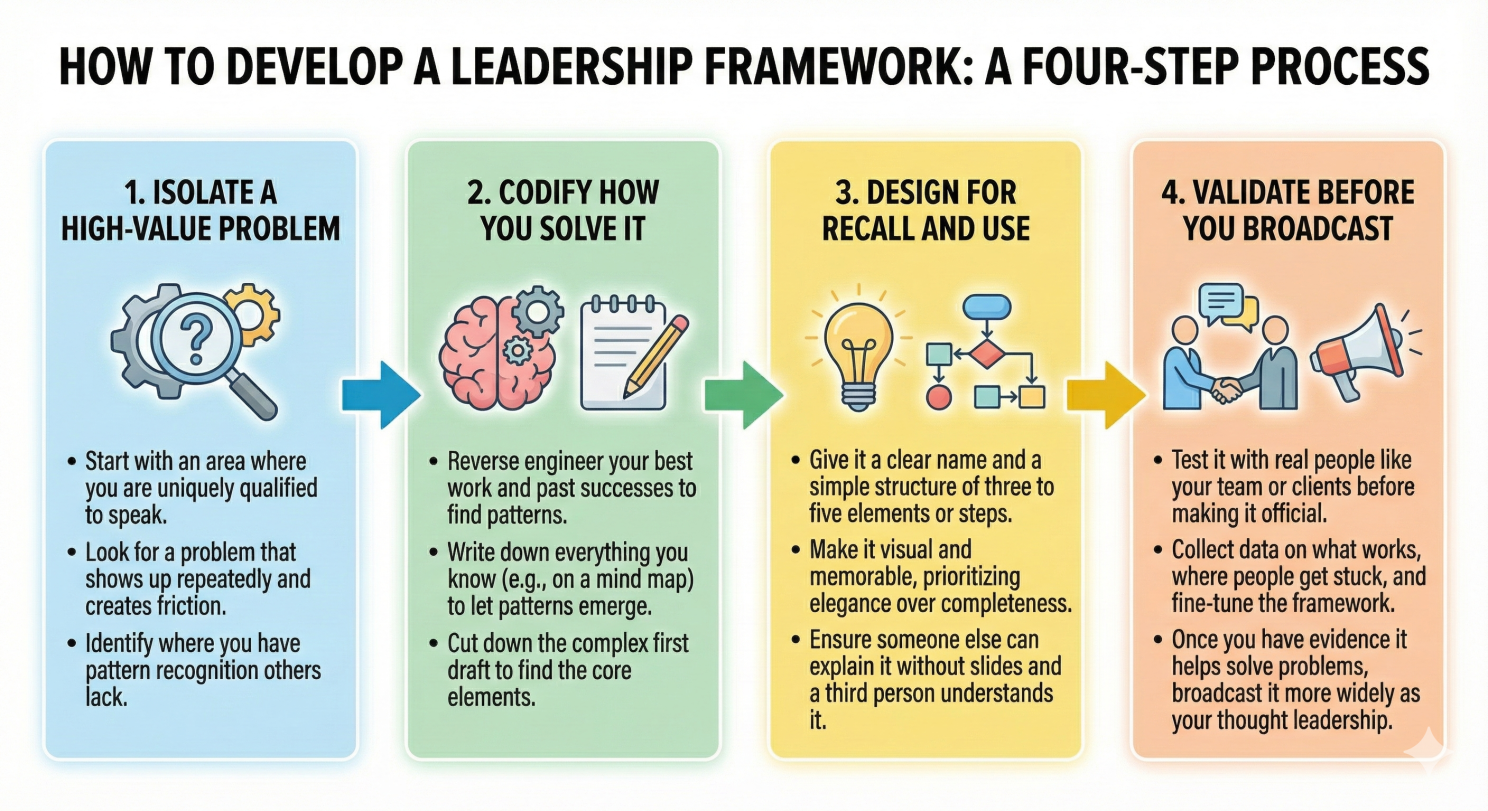
Isolate a high-value problem, codify how you solve it, design it for recall, and validate it before you broadcast it.
Step one is to isolate a high-value problem. Pick something you are uniquely qualified to speak to and that creates friction when it comes up. The test is pattern recognition. If people ask you about it repeatedly and still lack a clean tool, that is your starting point.
Step two is to codify how you solve it. Reverse engineer your best work. Look at your last three wins in this area and ask what you did first, what you noticed that others missed, and what trade-offs you made. Write down everything, all the resources and approaches and examples, then let it sit. Your first draft will have twelve steps and seventeen sub-points, and that is fine. Then cut it to the core.
Step three is to design for recall and use. If other people cannot explain it to a third person, it will not stick. Give it a clear name with no far-fetched acronym, something that hints at what it does. Keep it to three to five elements, because our brains hold patterns of three easily and they like visuals. If you can sketch it on a whiteboard and it still makes sense, you are in good shape.
Step four is to validate before you broadcast. Do not launch it on LinkedIn first. Run it by your team and use it with clients. Watch where people get stuck, what language lands, and what actually changes behavior. Maybe one step is really two. Maybe people skip the third element because it does not feel necessary. Collect that. Once you have evidence it helps people solve a real problem and they can pass it on without you, that is when you take it wider.
The signal that it is working is simple to spot. People start using your terminology in meetings and referencing your model when you are not in the room.
How simple does a framework need to be?
Simple enough to remember and use without slides. If it takes a 30-minute explanation before anyone can apply it, it is too complex.
If you believe your work is too nuanced or situational for a framework, that is usually a sign you have not spent enough time simplifying it. Anyone can explain something at length. Few people can reduce it to something simple enough to remember and use, and that reduction takes real understanding of what other people need to be effective.
Simon Sinek’s Golden Circle is the example I point to. Purpose-driven leadership was not new. What he did was codify it into three elements: why, how, what. Logical, easy to remember, easy to teach, easy to draw. People had the aha moment not because it was novel but because it was simple enough to click and then repeat to their own teams.
A good rule of thumb: your framework should be 80% of the solution and 100% memorable. That will serve you better than something that is 100% complete and 0% memorable.
What mistakes make a framework useless?
There are two. Building something that describes instead of guides action, and over-engineering complexity to look smart.
The first mistake is a framework that only categorizes. “Here are four types of managers” gives people awareness but does not help them decide anything in the moment. Our own Manager Archetype Quiz is an example of this. It sorts common behavior patterns and gives insight, but the archetypes do not solve a problem on their own, so it is a tool for reflection rather than a framework. A real framework helps someone take action.
The second mistake is adding complexity to signal intelligence. Complexity is easy and simplicity is hard, so do the work to simplify. If your framework has to cover every edge case to feel legitimate, you are optimizing for the wrong thing. It needs to be effective for most situations, not exhaustive for all of them.
Frameworks are your intellectual property
Frameworks are not a thought-leadership accessory. They are how you make your expertise scalable, multiply your impact, and make your next promotion easier to justify. If you can name the problem people keep coming to you for, and the process you have nailed down but never written out, you already have the raw material to start.
If you want help getting that out of your head and into a framework you are known for, that is a big part of what executive coaching with us is for. You can schedule a strategy call to talk it through.
Frequently asked questions
How long should it take to explain a framework? If someone needs a 30-minute setup before they can use it, it is too complicated. Aim for something that fits on one page and that a person can apply after hearing it once.
Is a framework the same as a model, a quiz, or an archetype? Not quite. A quiz or archetype that sorts people into types builds awareness but does not tell anyone what to do next. A framework guides action. If yours only labels and categorizes, keep working until it helps someone make a decision.
Can a framework have more than five steps? It can, but it usually should not. Three to five elements is the range most people can recall and repeat. If you have ten steps, you have not finished cutting it down to the core.
Do you have to be a senior leader to build a framework? No. The requirement is pattern recognition, not title. If you solve a specific problem repeatedly and notice things other people miss, you have enough to start, regardless of your level.
When should you share a framework publicly? After you have tested it with real people and seen it change behavior, not before. Use it with your team and clients first, fix what confuses them, then broadcast it once you have evidence it works.