

A status update costs you authority when it reports effort instead of judgment. Senior leaders read density as friction rather than rigor, so the thorough walkthrough you prepared gets filed one level below where you belong. To hold authority, open with the decision you made, name the risk you accepted, make one specific ask, and set the condition under which you will interrupt them next.
Key takeaways
An update and a briefing can carry identical information and produce opposite perceptions. One asks to be evaluated, the other exercises judgment.
Research on processing fluency found that added complexity lowered how intelligent readers judged an author to be, independent of the underlying quality of the work.
The Decision Line separates what you did (effort) from what you decided (authority). Competent people spend most of their airtime below it.
Four moves keep you above the line: lead with the call, name the risk you accepted, make one ask, set a tripwire.
Speaking time predicts who a group sees as the leader, but the content of that airtime determines whether it reads as leadership or as workload.
Why do status updates make you sound less senior?
Because they answer the question that was asked out loud instead of the two questions underneath it.
Someone senior says “where are we with that.” What they are actually trying to learn is what they should be worried about that is not yet on their radar, and what you need from them and by when. The gap between the question asked and the questions meant is where seniority gets assigned. Fill it and you get read as a peer. Miss it and you get read as a doer, no matter how strong the work is.
I worked with a director running a large program who walked into a quarterly review. The SVP opened warmly: “Can you walk us through where things are right now?” She took the invitation. She started at the beginning, moved through the work streams in the order they happened, and saved the risks for the end because she wanted to land the wins first. About twelve minutes in, a VP said, “It sounds like the integration slipped.” She explained the vendor delay, the resource constraints, the two weeks of back and forth with legal. All of it was true. All of it read as excuse-making, because it arrived only after she was challenged.
Nothing in that update was inaccurate. That is why the pattern survives for years without anyone naming it.
What is the difference between a status update and a briefing?
They can contain the same facts and function as two different transactions.
An update is a request to be evaluated. You hand over the raw material and ask someone senior to form a view about whether you did enough. A briefing is an exercise of judgment. You tell the room what you have already concluded and invite them to correct you or add what you are missing.
The words in the room barely change. What changes is who is doing the assessing. In the first version you have handed the assessment to someone else, usually in front of an audience. In the second you have done it yourself and put the result on the table.
What is the Decision Line?
Picture a horizontal line running through everything you could possibly say in a meeting.
Below the line sits what you did, how long it took, who you met with, what tool broke, how hard it was. Below the line is where the effort lives. Above the line sits what you decided, what risk you accepted, what you need, and when you will interrupt someone next. Above the line is where the authority lives.
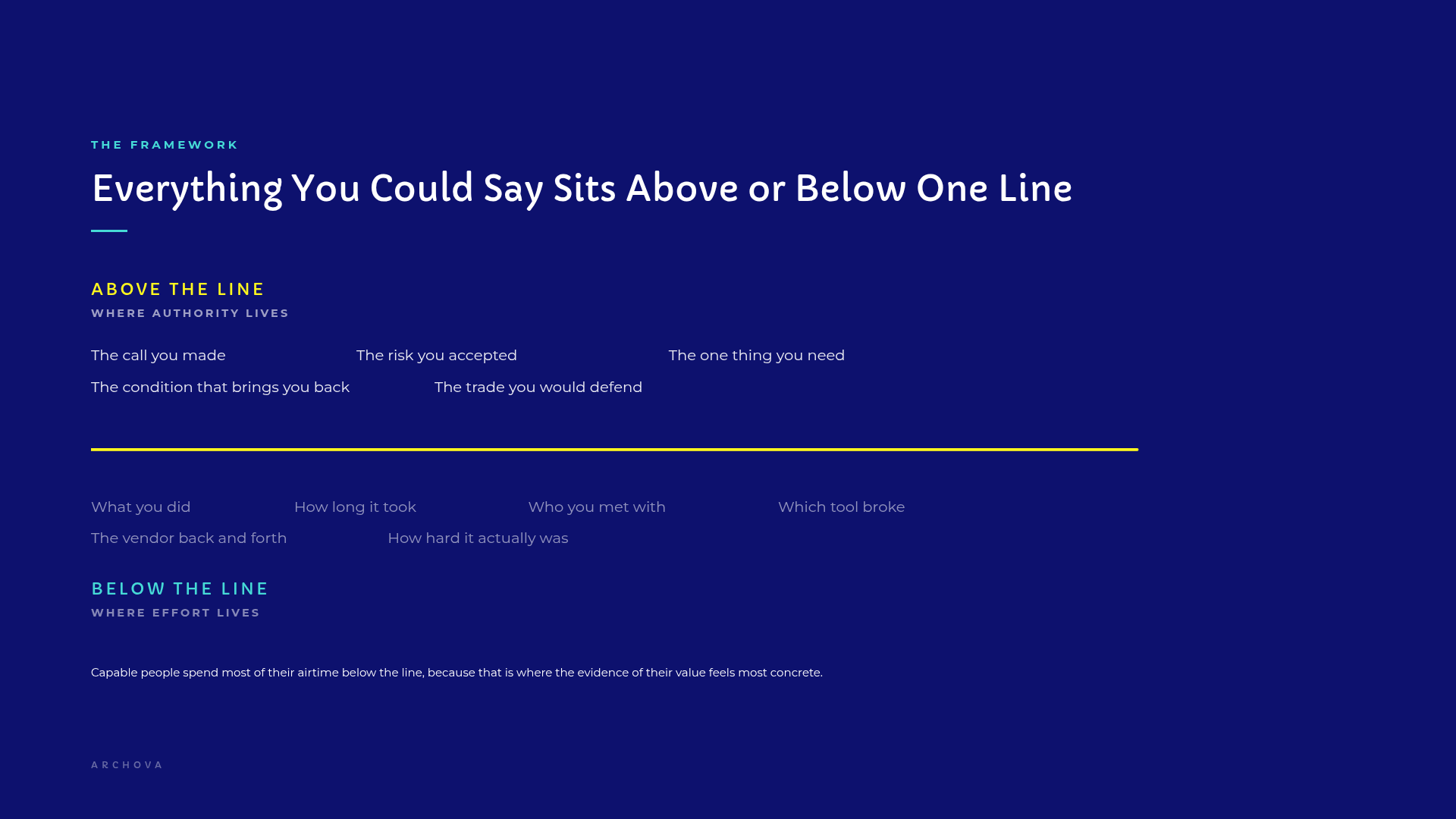
Competent people spend most of their airtime below the line, because that is where the evidence of their value feels most concrete. The meetings, the pushback, the late nights, all of it is tangible and real. That instinct is the trap. The room is not scoring tangibility.
There is a related habit worth naming. Chronological order is how you describe what happened to you, and it quietly gives up your agency. Priority order is how you show that you ranked things, which is the actual job. Speak in time order and you are narrating an experience. Speak in priority order and you are reporting judgment.
What are the four moves that keep you above the Decision Line?
1. Lead with the call
The first sentence sets the altitude, and nobody can raise it for you afterward. Find the one sentence in your update that someone could forward to another person without editing it, and move it to the top.
“We will ship on the 14th with the integration scoped down to two partners.”
You do not need to script the whole update. Write that first sentence down and read it a few times before you walk in.
2. Name the risk you accepted
A risk you name out loud is a decision you made. The same risk surfaced later by someone else is a failure you concealed. Same facts, opposite readings.
“The trade I took is a thinner testing window. If that worries you more than it worries me, now is the moment to say so.”
Find one risk per update and state it before anyone asks, in a full sentence that includes the word I.
3. Make one ask
An update with no ask in it functions as a request for approval. An update with a specific ask allocates someone else’s authority, which is what senior people are in the room to do.
“What I need from you is a decision on the vendor by Thursday. Everything else is mine to run.”
If you have three asks, rank them, bring the first one, and offer to send the other two by email.
4. Set a tripwire
Part of seniority is telling people in advance under what conditions you will interrupt them.
“If the partner integration slips past the 21st, you will hear from me the same day. Short of that, the next update is on the 14th.”
Define the condition, not just the calendar date. A date on the calendar trains people to wait for you. A condition lets them relax and trust that you will surface the thing that matters when it matters.
What do you say when someone pulls you into the weeds on purpose?
Sometimes it is a real need for detail. Sometimes it is a status move, and the tell is that the questions keep going one layer deeper no matter how well you answer.
The counter is a rule I call one step down. Go exactly one level deeper than you were, stop, and hand the frame back.
“The delay came from a schema mismatch on their side. I can take you into the field mapping if that is useful, although my read is that the more useful question for this group is whether we hold the date. Which direction would you like me to go?”
One level, then a question. Never two levels without one. If you keep descending an inch at a time, you lose the frame without noticing.
There is a version of this to use before you are challenged, too. When someone asks about a slip, own the decision rather than the delay: “Yes, we were two weeks late, and that was my deliberate call. I traded the date for a cleaner data migration, and here is what the trade cost us and what it bought us.”
How do you check whether you are above the line before a meeting?
Answer four questions in under ninety seconds.
What did I decide?
What am I actually worried about?
What do I need from whom, by when?
Under what condition do they hear from me next?
If you can answer all four quickly, you are above the line. If you cannot, you are about to narrate.
What does the research say about detail and perceived competence?
Three findings are worth knowing.
Daniel Oppenheimer’s work on processing fluency found that adding complexity to a text lowered how intelligent readers judged the author to be. The effect ran through how easy the material was to process, and it held even when the underlying quality was strong. Applied to your Monday meeting, the density of your update is not being scored as rigor. It is being scored as friction. (Applied Cognitive Psychology, 2006)
The babble hypothesis, tested in a 2020 study in The Leadership Quarterly, found that speaking time predicted who a small group saw as the leader, and the effect survived controls for intelligence and personality. Airtime buys perceived leadership. What it buys depends on what fills it: airtime spent on judgment reads as leadership, airtime spent on narration reads as workload. (The Leadership Quarterly, 2020)
Naive realism, the concept Lee Ross and Andrew Ward developed, explains the last piece. We experience our own view of a situation as simply the situation, and then explain other people’s different views by concluding they are biased or not paying attention. It is why your boss can tell you that you are in the weeds while you are holding evidence that you were being strategic, and neither of you is lying. (Ross & Ward, 1996)
What do you do when your boss says you were in the weeds and you disagree?
Two people walk out of the same meeting with two different movies. Arguing about which movie was real does not resolve anything. Agreeing on the next scene does.
Mirror, share, redirect.
Mirror their experience. Say back what they experienced with enough accuracy that they stop bracing. No “but,” no “however.” Those words invalidate everything in front of them. “From where you sat, you went a month without a clear read on where we stand, and then heard about the mistake from someone other than me. That is a real problem, and I would have found it frustrating too.”
Share your movie in one sentence. Offered as information, not defense. The longer you go, the more it sounds like a rebuttal. “On my side, I was holding a vendor failure and trying to bring you a decision rather than a problem, and that was the wrong call on timing.”
Redirect to the next scene. This is the step people skip, and skipping it is what leaves the conversation unresolved. “Anything that moves the date by more than a week reaches you the day I know, even if I do not yet have a recommendation. Would that have solved it for you, or do you want something tighter?”
That last question matters more than it looks. It hands them a piece of authorship over the fix, which is usually what someone is reaching for when they push on you in the first place.
How do you get a whole team to stop over-explaining?
Install one word.
Set it up out loud in a team meeting so it becomes an agreement rather than an ambush. Anyone in a meeting can say “headline” to anyone, including you, and it means one thing: give me the top of it in one sentence.
It works because it removes the status cost from interrupting. Without a code word, a junior person who is lost has to choose between staying lost and creating an awkward moment with someone senior in the room. Most people stay lost. The word converts a hierarchy move into a shared protocol, and it forces the speaker to break out of narration mode and jump to the top of their own thinking.
In practice it sounds like this. Someone says, “We started with the original spec, then when the API changed in March we had to rebuild the connector, which shifted the QA window, and then Marcus was out, and there was also the staging environment issue.” Someone else says, “Headline.” The answer comes back: “We are two weeks late and I need a decision on whether to cut the reporting module.”
Then you go one layer deeper, on purpose, together. It regularly cuts several minutes off a meeting and nobody loses anything.
What is the trade-off nobody names?
Underneath a very thorough update there is often a quiet hope that if you show the full extent of what you handled, someone will register how hard it was.
That hope is human and it is expensive. It hands the evaluation to someone else, usually in front of an audience, and people with power do not hand out credit in response to evidence of effort. They hand out authority in response to evidence of judgment.
The alternative is to absorb the ambiguity and publish the conclusion. You do the messy thinking in private and carry the discomfort of not being seen doing it. Some of your best and hardest work becomes invisible. That is the trade senior people make, and most of them make it knowing every other senior person in the room is making it too. Invisible is not the same as unknown.
When you feel the pull to walk someone through all of it, the line is: “I am not going to walk you through how I got here. I will tell you what I decided and what would change my mind.”
What to do before your next update
Write the two lines you would send if you were only allowed two lines. First line is the call. Second line is the ask. Read them a few times before the meeting, then open with the first one.
You may feel exposed the first time. That is what behavioral change feels like from the inside, and it is a reasonable sign that something is actually shifting.
An IC reports progress against a plan someone else owns. A leader allocates attention, theirs and yours and the room’s. Every update you give is a small vote on which one you are.
Nobody promotes you for the work you can describe. They promote you for the calls you are willing to make.
Frequently asked questions
Does this mean I should hide the details of my work?
No. Hold the detail and let the room ask for it. Say what you decided and what you need, then offer to go deeper on whichever piece they name. The detail still exists, it just stops being your opening move.
What if my manager explicitly asks for a full walkthrough?
Give it, and start with the headline anyway. One sentence of conclusion before the walkthrough costs you nothing and frames everything that follows. If they wanted the raw sequence, they still get it thirty seconds later.
I am an individual contributor without direct reports. Does the Decision Line apply to me?
Yes. The line has almost nothing to do with headcount. An IC reports progress against a plan someone else owns. A leader allocates attention. Senior ICs and expert leaders get read the same way people managers do.
What if I genuinely have not made a decision yet?
Then your headline is the decision you are about to make and the date you will make it. “I am holding the vendor call until Thursday because I want the load test results first” is still a position. Undecided is different from unowned.
How do I use this in writing, not just meetings?
The two-line rule transfers directly. If your manager could only read two lines from you this week, line one is the call and line two is the ask. Put those at the top of the email and everything else below a line break.
Will leading with the conclusion make me look arrogant?
It reads as arrogant when the conclusion arrives without an invitation to push back. Pair the call with a genuine opening, such as naming the risk you accepted and asking whether it worries them more than it worries you.
Ramona Shaw is a leadership coach and the host of The Manager Track podcast. This article is adapted from Episode 328. If you want to go deeper on how you come across to people with power over you, the Executive Presence Intensive is an eight-week program built for exactly that.